Strategic intelligence methodology for consulting firms in 2026
A structured process, source typologies, deliverable formats and common mistakes: the operational framework for effective strategic intelligence in a consulting firm.
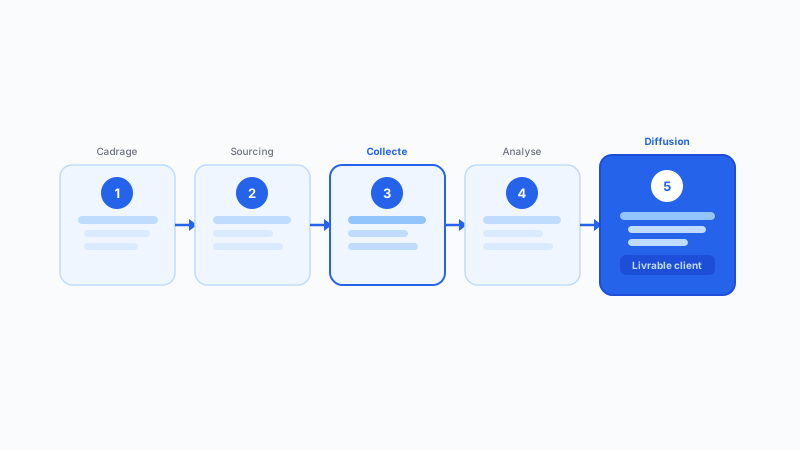
Strategic intelligence is one of the rare consulting activities where method makes all the difference. Two firms can draw from the same sources, access the same databases and spend the same budget, one produces notes that shape multi-million-euro decisions, the other publishes a press digest that no one reads. The gap rarely comes down to the quantity of information gathered. It comes down to the rigour of the process.
This article details the operational framework we observe in firms that have turned their intelligence practice into a genuine competitive advantage: process steps, source portfolio construction, deliverable formats adapted to different audiences, and common mistakes to avoid.
Strategic intelligence cycle adapted for consulting firms
Step 1: need framing, the primary skill
Every intelligence cycle begins with a question, and that is precisely where most firms fail from the outset. The brief "monitor our sector" is not an intelligence question; it is the absence of one. It invariably produces oversized feeds, overly general notes and a fatigue that kills the practice within six months.
An operational intelligence question meets three criteria. It is decision-oriented: it helps to choose, not merely to describe. It is time-bounded: the relevance horizon is defined. It is falsifiable: you can imagine an answer that actually changes something in the firm's or the client's analysis.
Examples of useful reformulations:
- "Pharma sector" → "Will the new accelerated market authorisation pathways in oncology change the entry window for our client over the next 18 months?"
- "Competitive intelligence" → "What acquisition or fundraising signals are the three main competitors of our client sending this quarter?"
- "Regulatory trends" → "Which texts currently being transposed in France and Germany affect our mobility consulting scope by end of 2026?"
Framing takes 30 minutes per intelligence profile and conditions the entire downstream chain. Skip it, and collection will be vast, analysis diffuse and the deliverable unread.
Step 2: building the source portfolio
A good source portfolio is not measured by its size but by its coverage without redundancy. The goal is to capture significant signals without creating an unmanageable processing load.
The taxonomy that works in practice distinguishes five families:
Primary regulatory sources. Official journals (EUR-Lex, JORF, Bundesanzeiger), sectoral regulator websites, public consultation bases, state aid registers. These sources produce little but at maximum reliability. They must be monitored first.
Primary actor sources. Official press releases, financial results publications, regulatory filings (AMF, SEC, Companies House), institutional websites of monitored actors. High reliability, but with publication delays: these sources confirm what weak signals will often have already announced.
Specialist trade press. 5 to 8 titles maximum, chosen for their analytical depth, not their audience. A niche newsletter with 3,000 subscribers and an excellent exclusivity rate is often worth more than a large generalist title. The selection should be reviewed annually.
Research and think tanks. Two or three reference institutions per domain, with a focus on working papers and pre-publications, which often precede final publications by several months.
Weak signals and networks. Private professional forums, LinkedIn or X accounts of experts identified as primary sources (not amplifiers), job postings (a hiring shift is a strong signal of strategic change), patent filings where relevant.
A well-calibrated intelligence profile holds 25 to 40 active sources. Beyond that, the signal-to-noise ratio degrades.
Deliverable formats: adapting to the audience
The most common mistake in consulting firms is producing a single format for all recipients. A senior partner, a project manager and a client operational director do not have the same relationship to information and do not make the same decisions.
Three formats cover 90% of use cases:
The intelligence flash (1 page, weekly). Designed for partners and executive clients. Fixed structure: 3 to 5 signals ranked by importance, one line of context per signal, one line of implication. Reading time: 3 minutes. This format does not seek comprehensiveness, it seeks actionability.
The in-depth note (3 to 8 pages, monthly or thematic). For project teams and the client's operational counterparts. It develops a signal or theme in depth: context, timeline, actors, stakes, scenarios. It can be white-labelled, delivered directly under the client's name.
The quarterly intelligence report (15 to 30 pages). A capitalisation deliverable, designed for management committees. It aggregates the quarter's signals, places them within long-term trends and proposes a risk and opportunity map for the next 12 to 18 months. This format best justifies an intelligence subscription fee to a demanding client.
Format is not trivial: strong content delivered in the wrong format will be ignored. Deciding on the format before writing is part of the craft.
Common mistakes that kill the practice
Compulsive source accumulation. Adding a source is easy and reassuring. Pruning is difficult and rarely done. The result: portfolios that double in two years, manual review becoming impossible, and a de facto delegation to the tool that ranks by default, usually by recency, not by relevance.
Confusing collection with analysis. Many firms stop at step 3, they "do intelligence" in the sense of collecting articles, but produce no analysis. A consultant who forwards an article with "FYI" in the subject line is not doing intelligence; they are doing curation. The value-add lies in the interpretation layer.
Deliverable not adapted to the recipient. Sending an 8-page note to a partner who will only read the title, or a one-page flash to a project manager who needs to understand the nuances: in both cases, work is produced but not used.
Absence of periodic profile review. An intelligence profile built in January becomes stale by September if the client context has evolved. Intelligence questions deserve quarterly review: source relevance, format fit, question refresh. Without it, the practice drifts toward inertia.
Over-promising on AI. LLMs are remarkable productivity amplifiers for filtering and synthesis. They hallucinate on precise facts, figures and dates. A note produced with AI assistance without human verification of factual elements is a note that creates reputational risk for the firm.
How Sentinel Briefing structures this cycle
Sentinel Briefing is designed to handle steps 3 and 4, automated collection and AI filtering, while leaving the consultant in charge of steps 1, 2 and 5, which create the differentiating value.
Intelligence profiles are configurable per client, with explicit intelligence questions that instruct the filtering. Deliverables export as white-label PDFs ready to send. Human review remains the final link, and must stay so. The tool frees time on the mechanics so the consultant invests that time in interpretation.
From €19 per month, the complete cycle, from collection to distribution, fits within less than one hour of human work per week per client profile.
Move to intelligence that delivers
Sentinel Briefing turns your sources into ready-to-share analysis notes. Free plan with no time limit, no credit card required.
Try for free