From intelligence to deliverable: billing for analysis, not collection
Consulting economics: why the value in an intelligence service lies in analysis, how to repackage the offering to bill accordingly, and what automation changes in the equation.
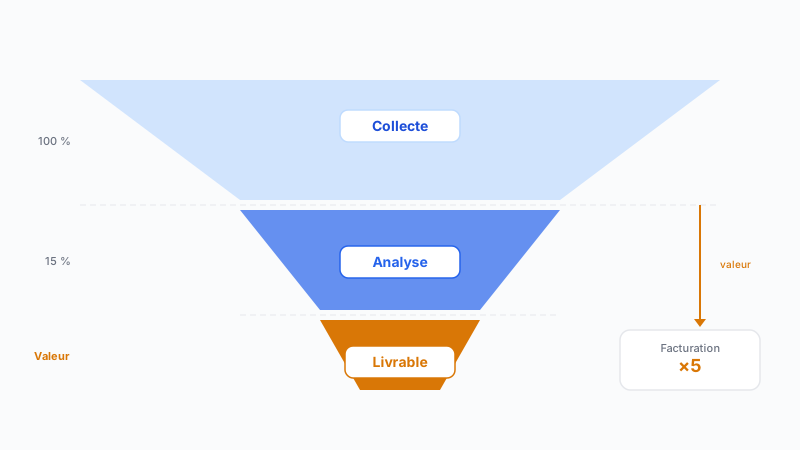
There is a paradox at the heart of the economics of intelligence in consulting. The least skilled task, gathering information, absorbs on average 60 to 80% of the time devoted to intelligence. The most skilled task, analysing what that information means for the client, receives 20 to 40%. And in the vast majority of firms, the fees billed do not distinguish between the two: the client pays a global service whose collection component they neither see nor value. Result: the firm sells at consultant rates hours that are worth, in terms of real differentiation, less than those of a research librarian.
This imbalance is not inevitable. It is the product of an organisation designed for an era when collection was hard and the value of raw information was real. In 2026, collection is trivial. The value is in interpretation. Repackaging the intelligence offering to bill for analysis requires revisiting three levels: time, the deliverable, and the pricing model.
Why collection is almost worthless now
Information is abundant. A firm that wants to monitor a sector can access, within a few hours, tens of thousands of sources, press, regulations, analyst reports, patent data, professional forums, earnings call transcripts. This abundance has devalued information access. What had value ten years ago, knowing the right sources, no longer has much. Your competitors have access to the same sources.
What remains rare is the ability to read a signal within that flow, connect it to the client's specific situation, and formulate a recommendation the client would not arrive at alone. This ability cannot be automated. Nor can it be handed to someone who does not know the file. It is the product of deep understanding of the client context, which makes it the most valuable part, and the only one that deserves billing at consultant rates.
The deliverable, not the report
The confusion between "intelligence" and "intelligence report" is the second economics mistake. An intelligence report describes what has happened. A consulting deliverable answers a question, and suggests an action.
The difference is not rhetorical. It determines whether the document will be read and whether it will justify the fees. A twenty-page regulatory intelligence report on sectoral developments can be produced by anyone with access to EUR-Lex. A four-page briefing that tells the client "here is what Article 47 of the proposed regulation means for your distribution strategy, and why you need to act before Q1 2027" can only be produced by someone who understands the client's situation. The first is hard to value above €200. The second can justify €2,000 as an addendum to an existing engagement.
The practical rule: an intelligence deliverable must contain at least one operational or strategic recommendation formulated in first-person plural, "we recommend that you...", "at this stage, the priority is to...". As soon as it is purely descriptive, it is collection dressed up as analysis.
Repackaging the offering
Three models work for monetising intelligence in a consulting firm.
The retainer briefing. The client pays a monthly flat fee, typically €500 to €2,000 depending on depth, to receive a structured thematic briefing, produced by the firm, on topics that directly concern them. This is not a press review subscription. It is a recurring analytical service, signed by the firm, with a weekly or monthly recommendation. The key to margin on this service: automate collection to the maximum, so consultant time is entirely devoted to analysis and writing.
The tactical intelligence note. On emerging topics, a regulatory proposal, a competitive acquisition, a market shift, the firm produces a four-to-eight-page note, delivered within two to five business days. Price: €800 to €4,000 depending on complexity and urgency. This product is often sold to existing clients outside current engagements, as an ad hoc service. It benefits directly from the firm's ability to detect signals quickly and analyse fast, which the automated intelligence tooling makes possible without growing headcount.
Integration into the engagement. Intelligence is not always a distinct product. Within a strategy or operational consulting engagement, regularly delivering an intelligence update to the client's governance, "here is what we are watching for you on this front", strengthens the firm's positioning, extends engagement duration, and creates a value dependency. It is not billed separately, but reinforces overall fees.
The pricing model that reflects value
Hourly billing for intelligence is structurally disadvantageous for the firm. It makes collection inefficiency transparent, and caps revenue per engagement. Moving to flat-rate or deliverable pricing decouples value from time spent, and this is precisely what automation enables.
In concrete terms: if a consultant previously spent six hours producing a briefing and billed €900 (6h × €150), and now produces the same briefing in two hours with an automated tool, the temptation is to keep billing €300. That is a mistake. The briefing has the same value to the client, possibly more, if better structured. The right answer is to bill €900 for two hours of work, and devote the four hours gained to producing more deliverables or deepening analysis. The tool's productivity does not translate into lower prices, it translates into higher margin.
What automation changes for the firm's economics
A well-deployed intelligence tool does not replace consulting. It redistributes the time budget. Before the tool: 75% collection, 25% analysis. After the tool: 10% collection (reviewing the pipeline output), 90% analysis and formulation. This redistribution has two direct economic effects.
First, the ability to produce more deliverables with the same number of consultants. Mathematically, if four hours freed on six allow producing twice as many briefings, revenue on that service doubles, delivered by the same team.
Second, average deliverable quality rises. The analyst no longer exhausted by collection has the time and energy to formulate a precise recommendation, challenge their first readings, and deliver something that deserves the consultant rate.
How we think through the equation with our clients
Sentinel Briefing is priced so that the equation holds even for small firms. Tool cost typically represents 3 to 8% of the revenue generated by the deliverables it makes possible. This is not a marketing assumption: it is what we observe from the first firms that have turned their intelligence practice into a billed offering. The constraint is not the tool. It is the willingness to change the model: stop billing for collection, and start billing for analysis.
Move to intelligence that delivers
Sentinel Briefing turns your sources into ready-to-share analysis notes. Free plan with no time limit, no credit card required.
Try for free