ROI of an AI intelligence tool for consulting firms: calculation and metrics
A practical method to calculate the ROI of an AI intelligence tool for a consulting firm: time gains, additional revenue, avoided costs. Quantified framework and tracking metrics.
Calculating the return on investment of an intelligence tool is an uncomfortable exercise. Many of the gains are diffuse, the contribution of a good intelligence note to a commercial win is rarely isolable, and decision-makers who sign the subscription are not always the ones benefiting most.
Yet the exercise is useful, not to retrospectively justify a decision, but to correctly calibrate the tool: are we overpaying relative to real usage, are we under-investing in a value pool, and which metrics should we track to arbitrate in six months.
This article proposes a pragmatic calculation method, suited to a consulting firm of 5 to 50 people.
Three value categories to separate
An intelligence ROI that adds everything together produces a reassuring but hardly actionable number. Better to separate three categories that follow different logics.
Category 1, Consultant time freed up. The most immediate and measurable gain. A consultant no longer spending two hours per week aggregating articles can reallocate that time to billable work, commercial development, or internal capitalization.
Category 2, Additional revenue on existing or new engagements. A white-label deliverable intelligence briefing can either be sold as an additional service (client intelligence subscription), or serve as a value demonstration strengthening commercial relationships.
Category 3, Avoided costs. Not stacking tools that never deliver anything ready to send, not paying for an oversized enterprise solution, reducing the time partners spend reacting to information already known to clients.
The three categories add up, but each is calculated and challenged separately.
Category 1: consultant time freed up
The baseline formula
Annual gain = (Hours saved per week × 46 weeks) × Valued hourly rate × Number of consultants involved
The three variables deserve attention.
Hours saved per week. Field observation across several deployments: a consultant producing their own intelligence typically spent 3 to 5 hours per week on a narrow client scope. With a well-calibrated tool, time spent on intelligence drops to 30-60 minutes per week, devoted to review, adjustment and dissemination. Net gain: 2.5 to 4.5 hours per week per consultant.
Valued hourly rate. The right rate is not the internal salary cost, it is the firm's hourly selling rate minus load factor. For a firm billing €1,200 per day, we typically use a valued hourly rate of €120 to €150. Some firms prefer reasoning at fully-loaded salary cost (€50 to €80 per hour for a senior consultant) for a more conservative valuation.
Number of consultants involved. Classic pitfall: counting the entire firm. Keep only those actually doing intelligence work before the tool, and whose saved hours translate into usable time (billable or commercially useful).
Worked example
A 15-person strategy consulting firm. 6 senior consultants each spent 3 hours per week on intelligence. Time saved with tool: 2.5 hours per week per person, or 15 firm-hours per week.
Valued hourly rate (conservative): €100.
Annual gain = 15 h × 46 weeks × €100 = €69,000 per year.
Against a firm-wide subscription at €2,400 per year (Pro plan at €200 per month over 12 months): ROI = 28×.
This figure looks high, but it rests on assumptions that must be validated. Above all: are the hours actually reallocated to value, or absorbed by something else?
The reality check: are the saved hours useful?
Legitimate criticism: if a consultant spends 3 fewer hours on intelligence, but those hours do not show up as additional billing or additional deliverables, the theoretical gain is partly fictitious.
Three concrete indicators to validate:
- Firm's average billing rate before/after (over 6 to 12 months).
- Number of deliverables produced per consultant per quarter.
- Time spent on commercial development (measured by calendar or self-reporting).
In observed firms, typically 50 to 70% of saved hours effectively translate into valued time. This halves the theoretical ROI but preserves a largely positive ROI in most configurations.
Category 2: additional revenue
Intelligence as a billed service
Some firms sell monthly intelligence service to their clients. Market rate observed: €300 to €1,500 per month per client, depending on depth. With a tool reducing production cost to 1 to 2 hours per month per client profile, gross margin on this offer exceeds 80%.
If a firm adds three €600 per month intelligence subscriptions to its portfolio, additional annual revenue is €21,600, already a multiple of the tool cost.
Intelligence as a commercial lever
More diffuse but often more significant: a well-built intelligence briefing, sent complimentary to a prospect, positions the firm as a sector expert. Several firms report a prospect-to-client conversion rate 10 to 20% higher when a thematic briefing accompanies the commercial approach.
Hard to isolate precisely, but detectable with simple tracking: list prospects sent a briefing in the past 12 months and compare their conversion rate to the firm's historical rate.
Intelligence as account reinforcement
On existing engagements, periodically delivering an intelligence briefing, even not billed separately, reinforces firm presence, justifies recurring fees, and lengthens average engagement duration. The effect on client retention is real but diffuse.
Category 3: avoided costs
Stacked tools
RSS reader, Google Alerts, paid newsletters, an AI assistant subscription to summarize it all: many firms pile up four or five tools, none of which delivers a note ready to pass on. Consolidating them frees up budget and, above all, the time spent every week stitching their output together by hand.
Downgrading from an enterprise solution
Firms that historically subscribed to Meltwater or equivalent pay €12,000 to €30,000 per year for oversized coverage. Moving to a solution fit for their size divides this cost by 5 to 10.
The opportunity cost of missed information
Harder to quantify but real. A firm that misses a strategic signal, an acquisition, a regulation, a new entrant, pays for it in credibility with the client. One or two such incidents per year are enough to justify the tool investment.
Tracking metrics to put in place
An intelligence tool deployed without metrics becomes invisible in firm reporting and ends up in a cost audit the following year. Six minimum metrics:
Usage metrics.
- Number of consultants active on the tool per month.
- Number of active intelligence profiles.
- Number of briefings consulted per week.
Value metrics.
- Number of briefings distributed to clients (internal to external).
- Number of engagements where a briefing was used as support.
- Client satisfaction rate on delivered briefings (light quarterly survey).
A simple dashboard on these six indicators, reviewed by a partner once per quarter, is enough to arbitrate knowledgeably at the next subscription renewal.
Synthetic three-line calculation
For a 15-person firm deploying Sentinel Briefing on the Pro plan:
- Annual tool cost: €2,400 (€200 × 12).
- "Consultant time" gain, conservative (50% reallocated): €34,500 per year.
- Possible additional revenue on 3 clients: €10,800 to €21,600 per year.
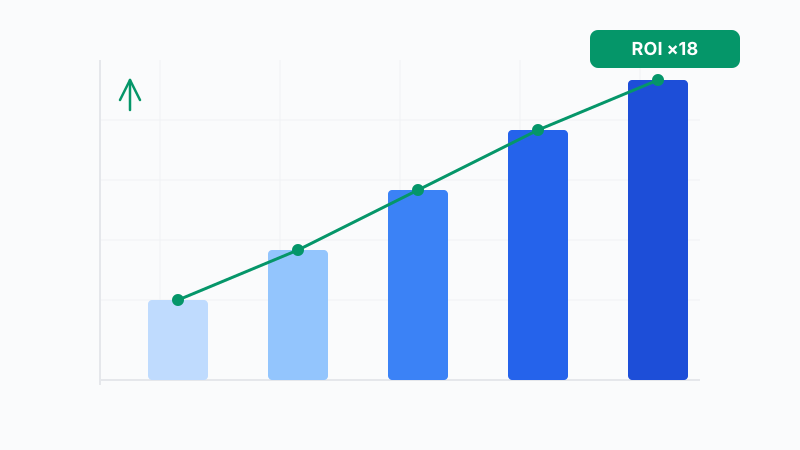
Realistic net ROI: 18× to 24× in the first year, before accounting for avoided costs and account reinforcement.
These figures obviously depend on the situation. Recommended exercise: take the method, replace assumptions with the firm's actual numbers, and iterate once per quarter on real metrics. Well-built ROI is not justification, it is a steering tool.
How we build ROI with our clients
We observed, supporting the first consulting firms using Sentinel Briefing, that the highest ROI is not always where expected. It is less the consultant time gained that matters than the ability to launch client intelligence offerings without growing the structure. Firms that turn their intelligence practice into recurring revenue typically find their ROI by the second quarter.
Sentinel Briefing is priced tightly so that this equation works from the first clients: from €19 per month on Solo, €149 on Team, €399 on Firm. We will soon publish quantified case studies from the first firms using the tool, in anonymized form.
Move to intelligence that delivers
Sentinel Briefing turns your sources into ready-to-share analysis notes. Free plan with no time limit, no credit card required.
Try for free